

Global IoT spending climbed from $726 billion in 2019 to $1.1 trillion in 2023, with projections showing 500 billion connected devices by 2030. In the same study, over 90% of companies reported running active IoT projects. The IoT market is surging, and sensor selection sits at the foundation of every product.
Selecting IoT sensors for your device is an early and consequential decision. A mismatched sensor may result in integration complexity, power budget failures, certification setbacks and delayed launches. The wrong choice compounds through firmware, hardware and supply chain, creating setbacks that derail timelines and budgets.
Read along to learn more about how performance factors, compliance standards and system-level architecture decisions all intersect in sensor selection.
Sensor Types for Smart Devices
Choosing the right sensor for IoT devices requires an understanding of the various types and where each excels.
Environmental Sensors
Environmental sensors enable IoT devices to monitor physical changes in their surroundings.
- Temperature and humidity sensors: Temperature and humidity sensors monitor climate conditions in smart buildings, track environmental parameters in industrial settings and ensure proper operating conditions for sensitive equipment.
- Pressure sensors: Pressure sensors serve diverse applications, including pipeline monitoring, heating, ventilation and air conditioning (HVAC) optimization and wearable altimeter functions. Selection depends on the pressure range your application requires and on whether the sensor will be directly exposed to the measured medium.
- Smoke and chemical gas sensors: Smoke and chemical gas sensors handle safety-critical applications. Smoke detectors protect residential and commercial buildings. Air quality monitors track volatile organic compounds, carbon monoxide and particulate matter. Chemical gas sensors in industrial environments detect hazardous leaks before concentrations reach dangerous levels.
Proximity, Touch and Motion Sensors for IoT Devices
Motion sensors detect movement through passive infrared (PIR), microwave or ultrasonic technologies.
- PIR sensors detect changes in heat signatures, making them standard in security systems and occupancy detection for smart buildings.
- Microwave sensors detect motion through frequency shifts and work through walls and other barriers.
- Ultrasonic sensors measure distance via sound waves and excel in precise proximity detection.
Proximity sensors detect the presence of objects without physical contact. They power industrial conveyor line monitoring, retail inventory tracking and parking systems. In contrast, touch and capacitive sensors create the human-machine interface layer in consumer electronics and control panels. They detect the presence of fingers through capacitance changes and support multitouch gestures and swipe patterns.
Proximity and touch sensor selection depends on detection range requirements and whether the target object is metallic or non-metallic. Capacitive proximity sensors handle both, while inductive sensors work only with metals.
Image, Biometric and Acoustic Sensors
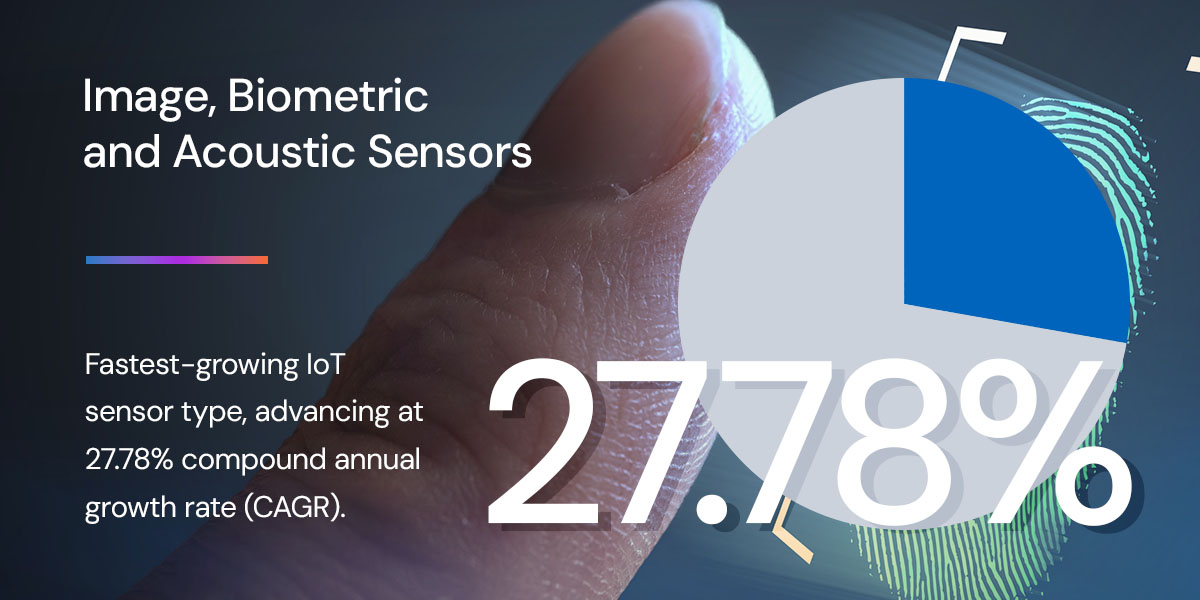
Image and optical sensors enable computer vision, quality inspection and smart security cameras. They're the fastest-growing IoT sensor type, advancing at 27.78% compound annual growth rate (CAGR). Image sensors range from low-resolution modules for basic object detection to high-resolution arrays for detailed visual analysis.
Biometric sensors combine sensing with onboard security processing for authentication and access control. Examples include fingerprint sensors, iris scanners and facial recognition modules that verify identity in smartphones and building access systems.
Sound and acoustic sensors power voice-activated devices, industrial acoustic monitoring and predictive maintenance programs that analyze vibration signatures. Industrial acoustic sensors, for example, detect equipment anomalies by monitoring frequency patterns that signal bearing wear or structural fatigue.
Key Factors for Selecting the Right IoT Sensor
Knowing your sensor type narrows the options. The right choice within that category depends on how well the sensor aligns with your application's performance requirements, deployment environment and total cost of ownership.
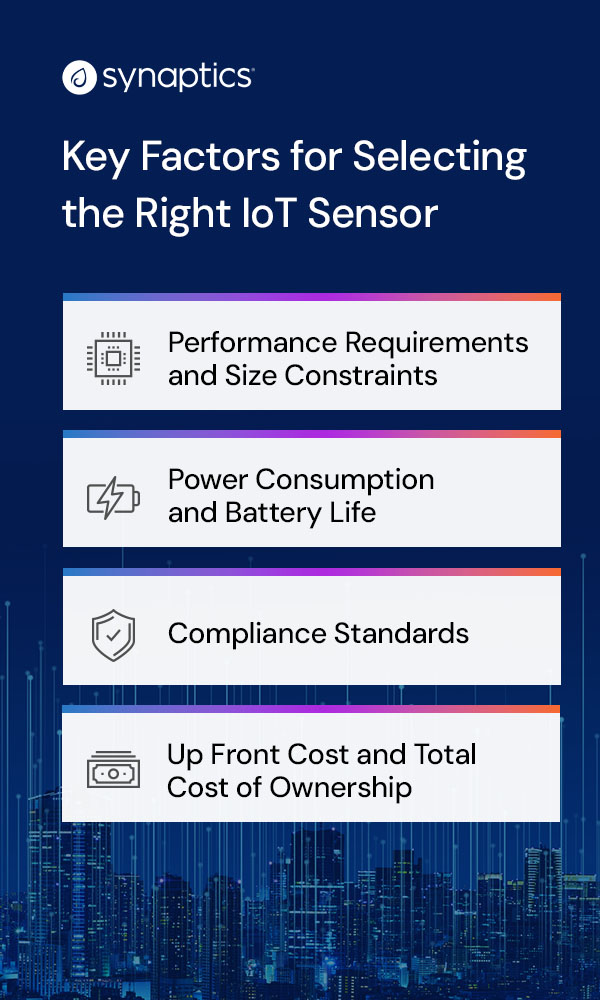
Performance Requirements and Size Constraints
The accuracy, range and form factor of your project will significantly determine the sensor you pick.
- Accuracy: Accuracy requirements vary dramatically by use case. For instance, medical devices and industrial process control require tighter tolerances than smart home climate control.
- Range: Measurement range is the sensor's rated minimum and maximum detection thresholds. Operating outside that range could degrade accuracy or damage the sensor.
- Form factor: Form factor includes physical size, mounting requirements and connector type. Wearables and space-constrained enclosures require compact sensor packages, while industrial applications may prioritize rugged housings over miniaturization.
Early in the design cycle, select sensors whose physical and performance specifications align with your product's mechanical constraints.
Power Consumption and Battery Life
Power consumption is one of the most critical factors when choosing a sensor for your IoT device. Sensors vary in active current draw, sleep current consumption and wake-up time. A sensor's duty cycle determines battery life more than its active power rating alone. Devices that spend most of their operating time in deep sleep can run for years on a single battery.
Studies show that power consumption can vary by up to four times among sensor boards running identical measurement routines. This variation arises from circuit design, power management implementation and the efficiency with which sensors transition between active and sleep states.
The communication protocol you choose also directly impacts the power budget. Wi-Fi draws significantly more power than Bluetooth Low Energy, Zigbee or Long Range Wide Area Network (LoRaWAN). Long Range (LoRa) enables transmission over distances of up to 20 kilometers at low power, making it ideal for outdoor and agricultural sensor deployments where cellular connectivity is impractical. A sensor's polling frequency also significantly impacts power consumption.
Compliance Standards
Knowing your target market's standards before selecting sensors prevents costly late-stage redesigns. Vulnerabilities in individual IoT components can compromise an entire system, even when other elements are secure. Security must extend across the full stack, from sensor hardware through firmware and communication protocols.
The European Telecommunications Standards Institute (ETSI) TS 103 645 defines 13 provisions for consumer IoT security. Their applicability depends on a device's functionality and its risk profile. The National Institute of Standards and Technology (NIST) also provides a comprehensive IoT cybersecurity handbook for IoT product manufacturers.
Regional regulations vary, and industrial IoT sensor solutions must also meet sector-specific standards, such as Food and Drug Administration (FDA) regulations for medical devices. It is essential to build compliance requirements into sensor selection from the start.
Upfront Cost and Total Cost of Ownership
Upfront unit cost rarely tells the full story. When evaluating sensor economics, factor in other essential considerations, such as:
- Calibration frequency: Chemical and gas sensors typically require periodic recalibration, leading to ongoing maintenance costs.
- Replacement cycles: A sensor with a three-year operational life may cost less upfront than a five-year sensor, but replacement labor and downtime can justify the higher investment, especially in large projects.
- Integration complexity: Integration complexity may translate to increased engineering time and redesign costs.
- Certification costs: Certification costs compound when sensors lack pre-certified modules or require extensive testing for regulatory compliance.
Matching Your Sensors to the Right Processor and Wireless Stack
The sensor's output interface, data rate and power profile must align with the embedded processor and wireless module the sensor connects to. Mismatches discovered late in development create friction that delays launches and forces expensive redesigns.
Processor Compatibility and Sensor Interface Requirements
Sensors communicate with processors through specific interface protocols. Selecting a processor that natively supports your sensor's output format simplifies integration and reduces cost.
Common sensor output interfaces include:
- Inter-Integrated Circuit (I2C): I2C handles multiple sensors on a shared bus but operates at lower speeds. This makes it suitable for low-bandwidth sensors, such as temperature, humidity and pressure modules.
- Serial Peripheral Interface (SPI): SPI provides faster data transfer for high-bandwidth sensors, such as image modules. It requires more pins than I2C but delivers higher throughput.
- Universal Asynchronous Receiver-Transmitter (UART): A UART offers simple point-to-point communication between a sensor and a processor. It's common in GPS modules and some environmental sensors.
Analog outputs require analog-to-digital converter (ADC) channels on the processor. If the processor lacks native support for your sensor's interface, you'll need additional translation circuitry that adds bill-of-materials cost and complexity.
Edge Processing
Processing sensor data directly on the device eliminates the need to send information back and forth to remote servers. The sensor captures data, the onboard processor analyzes it immediately and the device responds in real time.
This approach is faster because there's no delay waiting for cloud servers to process and return results. It's more private because sensitive data stays on the device rather than traveling across networks where it could be intercepted, and it keeps working even when internet connectivity drops or slows down. For example, a smart security camera with edge AI detects motion and identify potential threats locally, without relying on a constant internet connection.
Multimodal Sensor Fusion and Embedded AI Processors
Multimodal sensor fusion combines data from vision, audio, touch and environmental sensors to create richer contextual awareness. This approach requires processors with sufficient AI compute capacity to handle multiple data streams simultaneously. Microcontrollers (MCUs) suit simpler, single-purpose sensor tasks, while AI-enabled microprocessors (MPUs) and systems-on-chip (SoCs) handle complex fusion workloads that process video, audio and motion data in parallel.
Successful sensor integration with embedded processors requires chips that deliver sufficient processing power, flexible interface support and energy efficiency across diverse IoT applications. Choosing the right embedded processor for your sensor configuration prevents mismatches that surface during integration testing.
Wireless Protocol Selection and Data Transmission
Choosing the right wireless protocol depends on your sensor's data characteristics and deployment requirements. Different protocols serve different needs based on bandwidth, range and power consumption.
- High-frequency, high-data sensors, such as image and audio modules, typically require Wi-Fi or 5G connectivity.
- Low-power, low-frequency sensors, such as environmental and proximity detectors, work well with Bluetooth Low Energy (BLE), Zigbee, Thread and LoRaWAN.
Wi-Fi dominates applications where bandwidth outweighs power concerns. It held a 24.12% revenue share in 2025, according to Mordor Intelligence, making it the most common choice for high-data sensor deployments, such as security cameras and industrial quality inspection systems.
LoRaWAN and Sigfox protocols excel at enabling long-range, low-power IoT sensors. These protocols are expanding at a 31.75% CAGR, representing the fastest-growing connectivity segment in IoT sensors. LoRa's ability to transmit up to 20 kilometers makes it ideal for outdoor and agricultural sensor deployments where cellular coverage may be sparse or nonexistent.
Multiprotocol connectivity platforms simplify deployment in environments where multiple sensor types coexist. A smart building might use Wi-Fi for security cameras, BLE for occupancy sensors, and Thread for lighting controls. Managing multiple protocols through a unified platform reduces integration complexity and streamlines device management.
Note that all data in transit requires encryption per ETSI Provision 5.5 and industry security standards. Wireless protocols must support appropriate encryption mechanisms, and processors must have the computational resources to handle encryption overhead without degrading sensor data throughput. IoT edge computing and machine learning architectures that unify connectivity, compute and security simplify most integration challenges.
How Industries Use IoT Sensors
Sensor types and selection criteria vary by industry. Understanding how your sector uses sensors sharpens your own specification decisions.
- Healthcare and medical devices: Electrocardiogram (ECG), electromyography (EMG), photoplethysmography (PPG), temperature, blood glucose and biometric sensors enable 24/7 monitoring, replacing legacy scheduled check-ins.
- Industrial and manufacturing: Manufacturing accounts for 21.46% of IoT sensor market revenue. Industrial environments rely on temperature, pressure, vibration, acoustic, proximity and gas sensors for predictive maintenance, equipment health monitoring, and process control. Industrial IoT sensor solutions prioritize ruggedness, long-term stability and integration with legacy control systems to withstand harsh conditions and multi-decade deployment cycles.
- Smart home and buildings: Sensors handle climate control, occupancy detection, energy management and safety monitoring in residential and commercial buildings. Power consumption and wireless range matter more than industrial-grade durability in these applications.
- Wearables and consumer electronics: Size and power constraints dominate sensor selection for wearables. Accelerometers, biometric sensors, optical PPG sensors and touch interfaces enable fitness tracking, authentication and gesture control in devices that must fit comfortably on the body. Form factor and battery life take priority over absolute measurement range or industrial resilience in wearable device sensors.
- Agriculture and environment: Humidity, temperature, soil moisture, chemical, gas and pressure sensors enable precision agriculture, irrigation optimization and air and water quality monitoring. Long battery life and extended wireless range suit remote agricultural installations where maintenance visits may be infrequent.
- Robotics and drones: Mobile platforms demand sensors that withstand continuous movement and vibration. Accelerometers, proximity, image and touch or force sensors enable navigation, obstacle avoidance and manipulation feedback. Response time and processing latency become critical when sensors feed real-time motion control loops, as delays of even milliseconds affect performance.
Build Smarter IoT Devices With Synaptics
Sensor selection establishes what your IoT device detects. The embedded processor and wireless connectivity platform determine what it does with that data. When sensor output, processing capability and wireless protocol align, the result is a production-ready device that scales reliably across deployment environments.
From wearables and industrial monitors to smart home devices and robotics, Synaptics provides the processing and connectivity foundation that turns sensor data into intelligent action. Synaptics Astra™ embedded processors deliver AI-native edge compute with multimodal sensor fusion, power efficiency and on-device security. They process touch, biometric, environmental and image sensor data locally without cloud dependency.
The Synaptics Connectivity platform supports Wi-Fi 7, Bluetooth/BLE, Thread, Zigbee and Global Navigation Satellite System (GNSS) in a unified, multiprotocol solution.
Contact us today to learn more about the best sensors for IoT applications.