

What Is DisplayLink Direct?
DisplayLink® Direct is a software development kit (SDK) from Synaptics that enables an application to send video content directly to connected displays, with full control over what appears on each one. DisplayLink technology is best known for its use in docks and adapters that add multiple monitors to any compute device, regardless of the native GPU limits. Together with the SDK, the technology now extends to embedded applications such as robotics, digital signage, meeting rooms, network displays, point-of-sale (POS) terminals, and thin clients.
How It Works
You embed DisplayLink Direct in your own application. Each time the application produces a frame, DisplayLink Direct encodes it on the host CPU and sends it over Ethernet or USB to the DisplayLink integrated circuit (IC), which decodes the content and drives the attached displays.
Content Control
Your application decides what appears on each DisplayLink IC–attached monitor, whether images or video. Every display has a stable hardware identifier, so content still lands on the right screen after a device is unplugged or power-cycled. You can span or mirror content across multiple displays, in full or in part, and keep them synchronized, which is exactly what video walls and digital signage need.
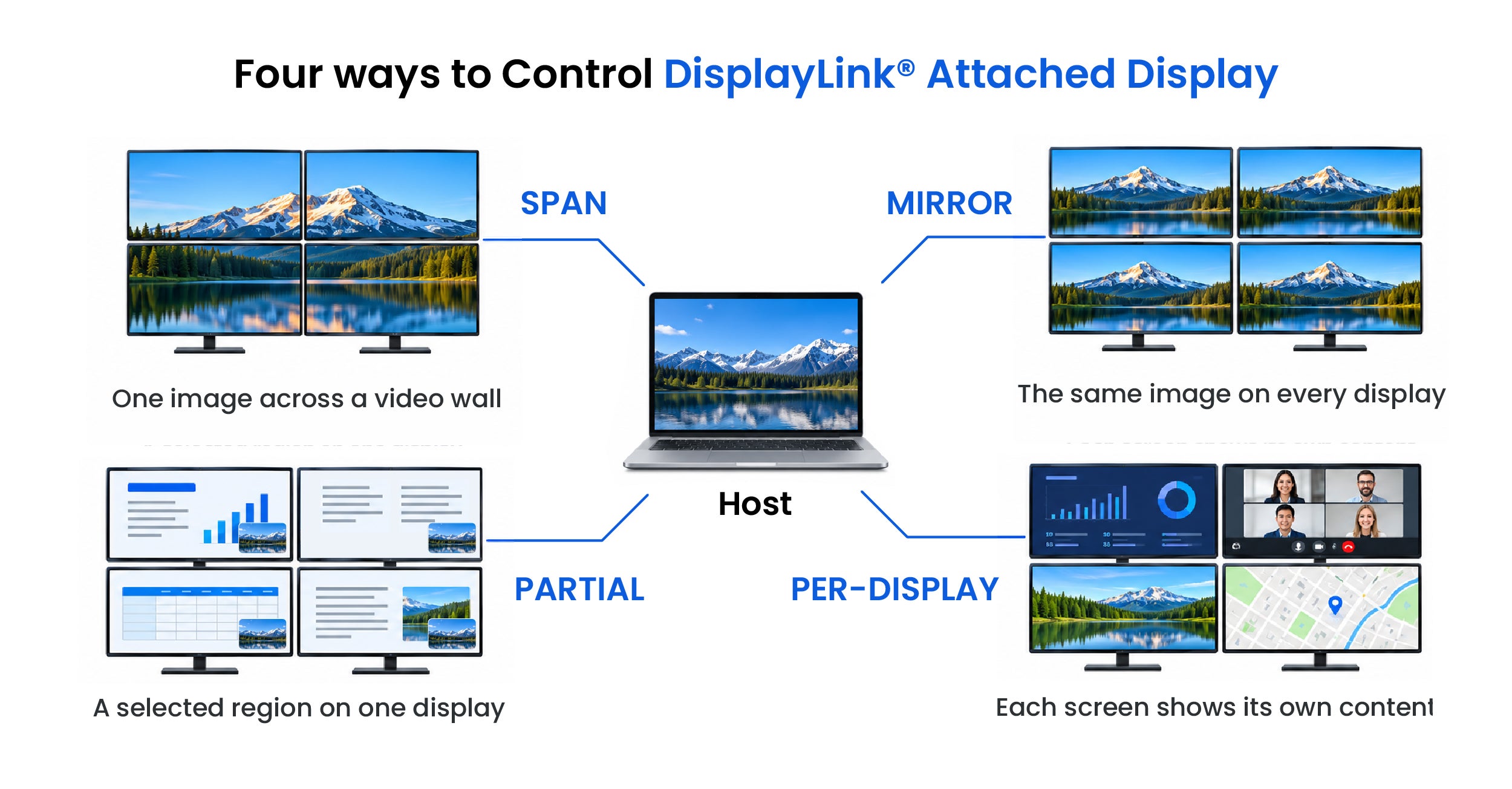
One application, many displays: DisplayLink Direct can span, mirror, or send different content to each screen.
Benefits for Embedded Designs
Beyond content control, DisplayLink Direct brings these additional advantages:
- Ideal for resource-constrained systems-on-chip (SoCs). DisplayLink Direct embedded mode uses the VESA Bulk Display Protocol (BDP) to send uncompressed pixels, which significantly reduces CPU usage. Available on the DL-7000 series, it suits single-display designs, with one host driving one display. For one host driving multiple high-resolution or high-refresh-rate displays, non-embedded mode sends compressed pixels instead.
- Lower cost and power. Your SoC does not need a GPU just to drive displays, which lowers both system bill-of-materials (BOM) cost and power consumption.
- Deploy on headless systems. Servers and computers without a traditional primary display can now drive monitors through DisplayLink. Today, the SDK runs on Linux (x86_64 and aarch64) and Android (aarch64).
Where DisplayLink Direct Fits
The same capabilities serve very different products. A digital signage player can drive several screens from one small, GPU-less host. Kiosks and POS terminals can run customer-facing and operator screens from one compact system. Thin clients and network displays can be managed remotely, with content updated from a central controller. In robotics, the robot’s own compute module can drive its operator and status screens directly. And in meeting rooms, a single appliance can support multiple room displays.
What It Means for DisplayLink Customers
DisplayLink Direct takes DisplayLink beyond docking, enabling customers to bring their DisplayLink products into new segments and benefit from an uncompressed video path where compression is undesirable.
How to Get Started
The API documentation, code samples, and getting-started guides are now available through the DisplayLink Direct documentation site on GitHub. You can work in C, C++, or Python, and integrate with Qt applications and Yocto Linux builds. Ready-to-run samples include a video wall, video clone, Extended Display Identification Data (EDID) reader, and screensaver. To talk through embedded mode or hardware selection, contact Synaptics.